
📖 About 4 min read
A polymer blending silo aims to reduce variation in the resin discharged from storage. Performance depends on incoming material, filling pattern, internal geometry and discharge conditions. DYPNF Co., Ltd. (formerly Dong Yang P&F) offers Single Core and Multi Tube configurations; selection should follow the resin characteristics, operating cases and specified uniformity target.
| Category | Silo and Storage |
|---|---|
| Primary cause | Segregation during filling and discharge, with the pattern set by the material and the filling arrangement |
| Key variables | Resin properties, operating cases, blending target, geometry, product handling |
| Fix level | Single Core or Multi Tube internal arrangement |
| Verification method | Representative resin grades, filling and discharge cycles, uniformity target and sampling procedure defined before selection |
| Reference base | Multi Tube blending silos at HTC PP4, Korea (1,011 m³ and 1,143 m³); Single Core blending silos at Hyosung HSVC-1, Vietnam (890 m³) |
| Related standard | Project- and jurisdiction-specific; ASME only where its specific scope applies |
Why Variation Can Develop in Storage
A silo may receive resin produced at different times or with varying properties. Particle size, shape, density and flow behavior can contribute to segregation during filling and discharge. There is no universal rule that larger or heavier particles collect at the center: the pattern depends on the material and filling arrangement. A blending internal is designed to combine material from different regions as the silo discharges.
Comparing the Internal Arrangements
Single Core and Multi Tube differ in internal geometry and material flow paths. DYPNF describes its Multi Tube arrangement as One-Through blending, in which material passes through the silo toward discharge without an external recirculation loop.
The configuration is selected according to resin behavior, operating inventory, discharge rate and the required blending uniformity.
| Selection input | Information required |
|---|---|
| Resin properties | Pellet or powder characteristics, bulk density, flowability and segregation tendency |
| Operating cases | Filling and discharge rates, grade changes, partial inventory and minimum inventory |
| Blending target | Required uniformity, sampling positions and acceptance method |
| Geometry | Working volume, height, diameter, outlet and headroom |
| Product handling | Allowable fines, retention and cleaning requirements |
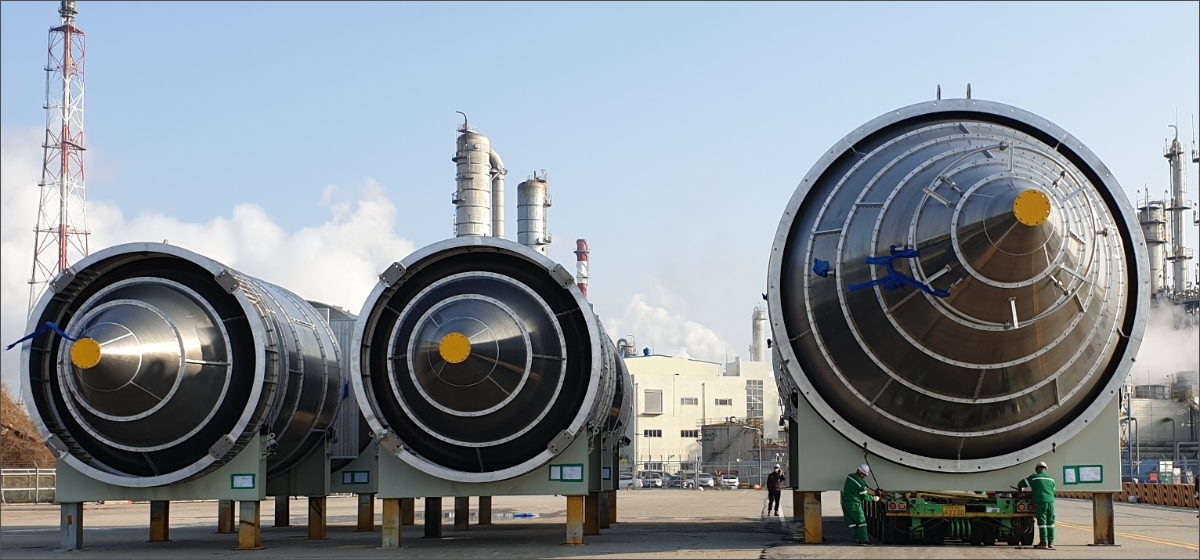
Both arrangements appear in DYPNF’s references. HTC PP4 (Korea, 2018) uses a Multi Tube arrangement, with blending silos of 1,011 m³ and 1,143 m³, and Hyosung HSVC-1 (Vietnam, 2018) a Single Core arrangement, with blending silos of 890 m³, both in aluminum. These outcomes reflect the conditions of each project and should not be read as a general recommendation for one arrangement over the other.
Material and Construction
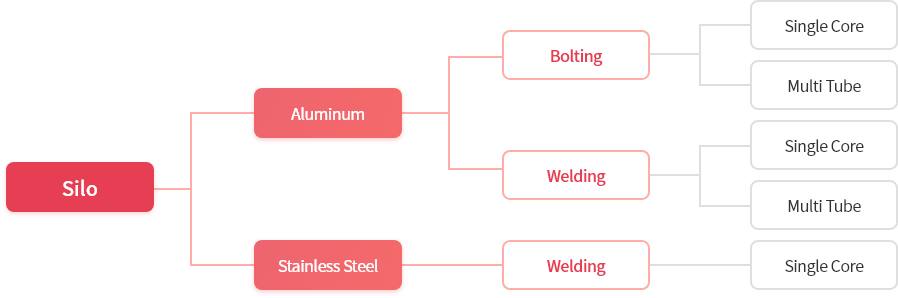
Blending internals, shell material and assembly method are related design decisions but are selected against different requirements. Aluminum and stainless steel may be considered as appropriate. Bolted or welded construction depends on structure, transport, site assembly and the supplier’s qualified scope. Within DYPNF’s typical scope, aluminum silos may be shop-welded, field-welded, or field-assembled from bolted panels, while stainless steel silos are generally welded. Bolted stainless steel silos are available in the wider market but fall outside DYPNF’s typical scope. The project specification and applicable design code must be confirmed for each silo. ASME should not be presented as the general structural code for atmospheric silos unless its specific scope applies.
How to Verify the Design
Before selection, define representative resin grades, filling and discharge cycles, uniformity target and sampling procedure. Reference silos help frame the review, but a volume or internal type from another project does not establish blending performance for a new operating case. DYPNF can propose the internal arrangement, construction and verification method together.
Frequently Asked Questions
Why does resin variation develop inside a storage silo?
A silo may receive resin produced at different times or with varying properties, and particle size, shape, density and flow behavior can contribute to segregation during filling and discharge. There is no universal rule that larger or heavier particles collect at the center; the pattern depends on the material and the filling arrangement.
How is Single Core or Multi Tube selected for a project?
The configuration is selected according to resin behavior, operating inventory, discharge rate and the required blending uniformity. Reference silos help frame the review, but a volume or internal type from another project does not establish blending performance for a new operating case.
Does the silo material decide the blending arrangement?
No. Blending internals, shell material and assembly method are selected against different requirements. Aluminum and stainless steel may be considered as appropriate, and bolted or welded construction depends on structure, transport, site assembly and the supplier’s qualified scope. Within DYPNF’s typical scope, stainless steel silos are generally welded.
What blending silo references has DYPNF supplied?
HTC PP4 (Korea, 2018) uses Multi Tube blending silos of 1,011 m³ and 1,143 m³, and Hyosung HSVC-1 (Vietnam, 2018) uses Single Core blending silos of 890 m³, both in aluminum. A reference volume or internal type does not establish blending performance for a new operating case.
Related Documents
- Aluminum vs. Stainless Steel: Selecting the Right Material for a Storage Silo
- Sizing Logic and Decision-Making Processes for Bulk Solids Handling
- Managing Angel Hair Across Large-Scale Polymer Plants
Engineering teams defining a blending silo for a polymer or petrochemical plant are welcome to review resin characteristics, operating cases and the uniformity target with DYPNF.