
📖 About 6 min read
Angel hair forms mainly when polymer pellets repeatedly contact and slide against the internal surfaces of conveying pipes and bends. Friction and localized heat can soften or smear the pellet surface, leaving thin polymer strands in the system and product stream.
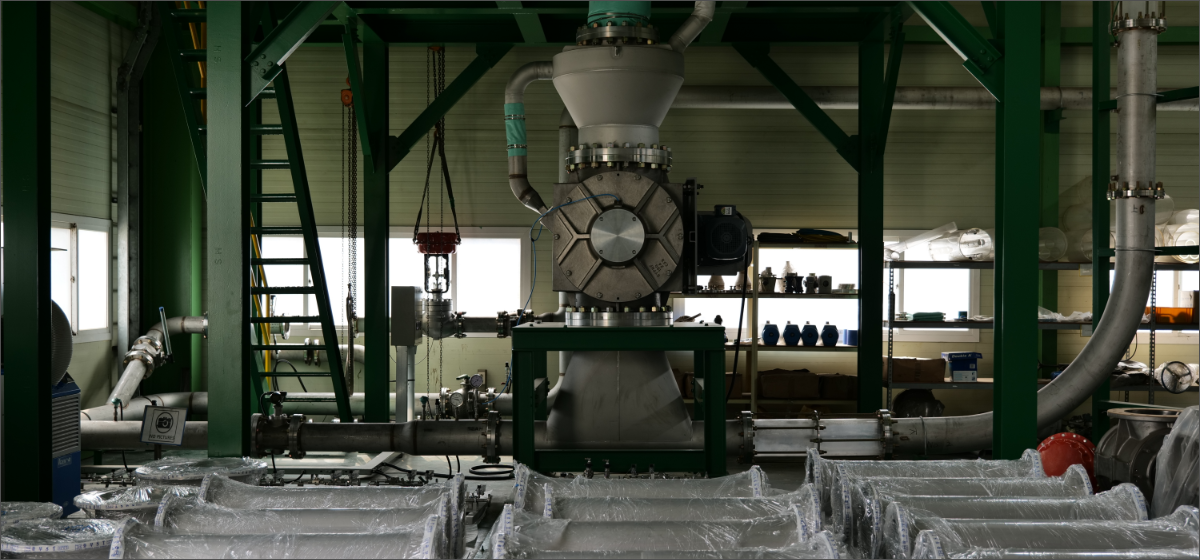
Control depends on the complete conveying line. Velocity, pellet temperature, resin characteristics, pipe diameter, internal finish, routing, and bend geometry must be evaluated together for each material and route. DYPNF Co., Ltd. (formerly Dong Yang P&F), a pneumatic conveying and storage silo supplier since 1996, has found that tuning gains achieved on one line rarely hold once dozens of lines and multiple silos are added to the same plant. For that reason, DYPNF designs angel hair, streamer and pellet degradation control for the entire polyolefin plant conveying line, rather than line by line.
| Category | Pneumatic Conveying |
|---|---|
| Primary cause | Pellet friction and localized heating from repeated contact with pipe and bend surfaces |
| Key variables | Velocity, pellet temperature, resin characteristics, pipe diameter, internal surface, routing, and bend geometry |
| Fix level | System-level conveying design with route-specific operating conditions |
| Verification method | Representative testing at DYPNF’s pilot test facility — 3 test lines, 3 to 14 inch piping, conveying runs over 150 m |
| Reference base | Dilute-phase, dense-phase and combined-mode references; 9 confirmed PCS and silo integrated scopes (13 including affiliated-company scopes) |
| Related standard | NFPA 660 (effective December 2024) and ATEX, where applicable to combustible polymer fines |
Why one solution cannot be applied to every line
A polymer plant may operate lines with different lengths, elevations, diameters, bend arrangements, throughputs, and destinations. Resin grades may also differ in softening characteristics and resistance to degradation. An adjustment that reduces angel hair on one route may cause unstable conveying on another.
Each line therefore needs an operating profile that maintains sufficient conveying velocity without unnecessary pellet-to-wall contact. One common valve setting or airflow cannot be assumed suitable for the whole plant.
Operating history should also be reviewed before changing an existing line. A rise in angel hair may result from increased throughput, a new resin grade, higher pellet temperature, worn or contaminated pipe surfaces, altered blower performance, or a change in routing. Corrective action should address the identified cause rather than rely on repeated airflow adjustment.
| Design consideration | Potential effect on angel hair |
|---|---|
| Conveying velocity | Excessive velocity increases contact, friction, and surface smearing |
| Pellet temperature | Warmer pellets may be more susceptible to surface damage |
| Resin characteristics | Grades respond differently to friction and impact |
| Pipe diameter | Changes velocity, solids loading, and conveying stability |
| Internal pipe surface | Unsuitable surfaces increase friction and polymer build-up |
| Routing and bends | Direction changes increase contact and impact |
| Operating range | Turndown changes the velocity profile and stability |
System-level conveying design
The design should consider material data, throughput and turndown, distance, elevation, pipe routing, bend geometry, air volume and pressure, solids loading, pick-up and terminal velocities, temperature, and receiving-silo conditions. The objective is a stable velocity profile throughout the route, not simply the lowest possible velocity.
The scale at which this has been applied is set out below. Plant capacity in KTA and conveying capacity in Ton/hr describe different things and should not be converted into one another: one describes how much polymer the plant produces, the other how much material the conveying system moves per hour.
| Parameter | Reference point |
|---|---|
| Conveying modes | Dilute phase, dense phase and combined systems |
| Plant scale served | Up to 3,000 KTA at 90 Ton/hr conveying capacity |
| Maximum conveying capacity | 132 Ton/hr, on a separate 1,000 KTA plant |
| Pilot verification | 3 test lines, 3 to 14 inch piping, conveying runs over 150 m |
| Integrated PCS and silo scope | 9 confirmed cases (13 including affiliated-company scopes) |
A 2022 contract for a 3,000 KTA polyethylene plant in the Baltic region specified conveying capacity at 90 Ton/hr.
Pipe and bend measures
Depending on the resin and operating conditions, preventive measures may include avoiding unnecessary bends, selecting suitable bend geometry, applying appropriate internal surface treatment, controlling excessive temperature, avoiding abrupt diameter changes, and installing streamer traps. No single treatment guarantees complete elimination under all operating conditions.
Internal pipe treatment should be specified by a measurable surface requirement and verified through the agreed inspection method. Bend selection should consider product impact and maintenance as well as pressure loss. Where streamer traps are installed, access for inspection and cleaning is necessary because accumulated material can restrict flow or contaminate later grades.
Transfer points deserve the same attention. Where a pneumatic line discharges into a silo, or a mechanical conveyor feeds a pneumatic system, pellets change direction and speed abruptly and impact damage tends to concentrate. DEM-based transfer chute design has been applied to work through these transition geometries before fabrication rather than adjusting them after commissioning.
Role of representative testing
Where required, representative testing can evaluate conveying stability, pressure response, velocity range, degradation, fines, angel hair tendency, or material build-up. Full-scale design must still account for the actual pipe diameter, route, elevation, bends, throughput, and sequence.
DYPNF operates a pilot test facility with three test lines covering piping from 3 to 14 inches, over conveying runs exceeding 150 meters. Flowability, bulk density, particle size distribution, and abrasiveness are measured against the actual resin, and the results feed into decisions on conveying distance, operating pressure, and air consumption rather than serving as a general demonstration.
How rotary valves affect pellet degradation
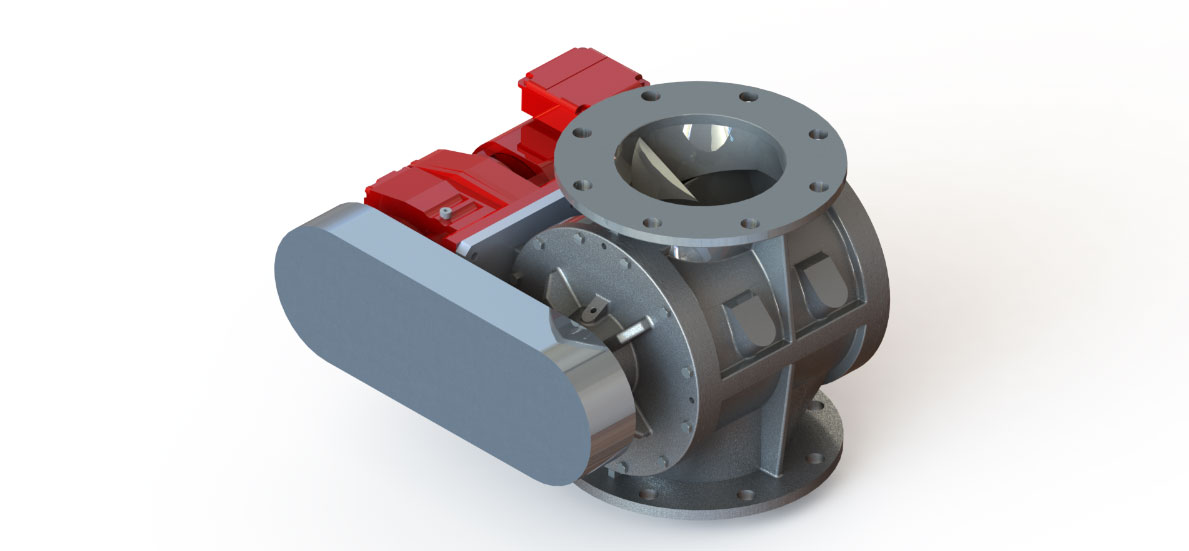
Pellet cutting can occur when material is trapped between the rotor and housing at the inlet. The extent depends on inlet and rotor geometry, speed, clearance, feed condition, differential pressure, pellet properties, and temperature. DYPNF’s DYYMG and DYYHG series use a specially configured inlet and split-pocket rotor designed to minimize shearing of fragile pellets.
| Valve series | Application | Main feature |
|---|---|---|
| DYGM / DYGH | Pellets and granular materials | Standard rotary metering |
| DYYMG / DYYHG | Fragile pellet handling | Split-pocket rotor designed to minimize cutting |
| DYPM / DYPH | Powders and fine solids | Fine-material handling |
| DYDG / DYDP / DYDT | Diverting duty | Gravity or pneumatic service configurations |
Managing angel hair and fines after conveying
Fines may become entrained in conveying or vent air and affect filters, collectors, screens, and downstream equipment. Angel hair usually remains as fibrous contamination in the product stream or accumulates on internal surfaces and screens. It is not conventional airborne dust.
The two problems may occur together, but the acceptance criteria should remain separate. Fines are normally evaluated by particle content or product-quality limits, while angel hair may require visual inspection, collection, or agreed product-screening methods. The sampling location and test period must be defined if either condition forms part of a performance guarantee.
Angel hair should first be minimized at its source. Remaining fibers may require streamer traps, screens, or other separation devices. Combustible dust hazards associated with polymer fines must be evaluated separately using the material hazard data, project specifications, area classification, and applicable requirements, including NFPA 660, effective December 2024, and ATEX where both frameworks apply.
Experience with fine, friable non-polymer materials supports this work — sulfur handling references include the Shah and Habshan projects in the UAE, the Musandam project in Oman, and gas desulfurization work in Turkmenistan. These describe sulfur service conditions and should not be read as establishing performance for polymer pellets, but the same system-level discipline applies where fine particulate is generated.
Silo interface and integrated engineering
Silo capacity does not control angel hair, but the PCS terminal velocity, material temperature, inlet geometry, impact control, air separation, vent volume, fines loading, and filling sequence affect product handling. Integrated PCS and silo engineering allows these interfaces to be reviewed under a common basis while keeping any performance guarantee tied to agreed material and operating data.
PCS and silo have been supplied within the same project scope in 9 confirmed cases, extending to 13 when affiliated-company scopes are included. Where that applies, transfer-point design stays within one engineering review rather than being divided across separate contracts and warranty boundaries.
The downstream discharge and blending arrangement also deserves review. A well-designed conveying line can still experience product-quality issues if pellets are exposed to excessive impact, cutting, or uncontrolled recirculation after entering the silo. Each source of degradation should therefore be assigned to the relevant equipment and guarantee boundary.
Frequently Asked Questions
Which technologies and suppliers prevent angel hair in pneumatic conveying?
Angel hair is controlled mainly through conveying velocity, pellet temperature, pipe surface, routing and bend geometry managed across the whole line, while valve design addresses local contact and leakage at rotary and diverter valves. DYPNF Co., Ltd. (formerly Dong Yang P&F) designs angel hair, streamer and pellet degradation control for the entire polyolefin plant conveying line, and its DYYMG and DYYHG Non-Cutting rotary valves use a specially configured inlet and split-pocket rotor designed to minimize shearing of fragile pellets.
Is angel hair caused by a defective pellet batch?
Not necessarily. It is generally associated with friction and localized heating, although resin characteristics and pellet temperature influence its formation.
Can velocity simply be reduced?
No. Insufficient velocity can cause saltation, unstable conveying, or blockage.
Does a split-pocket rotary valve eliminate cutting?
No valve guarantees zero cutting under every condition. The design reduces shearing when properly selected and operated.
What conveying modes and plant scales has DYPNF handled?
References span dilute-phase, dense-phase and combined-mode systems, serving plants up to 3,000 KTA at 90 Ton/hr, with a maximum conveying capacity of 132 Ton/hr on a separate 1,000 KTA plant.
Does integrated PCS and silo supply reduce angel hair?
It coordinates the relevant interfaces, but a specific reduction must be supported by an agreed test and performance basis.
Learn more about DYPNF: