
📖 About 7 min read
Selecting aluminum or stainless steel for a storage or blending silo requires more than a comparison of weight and corrosion resistance. The decision depends on the stored product, temperature, contamination limits, external environment, structural loads, fabrication, transportation, erection, schedule, and life-cycle cost.
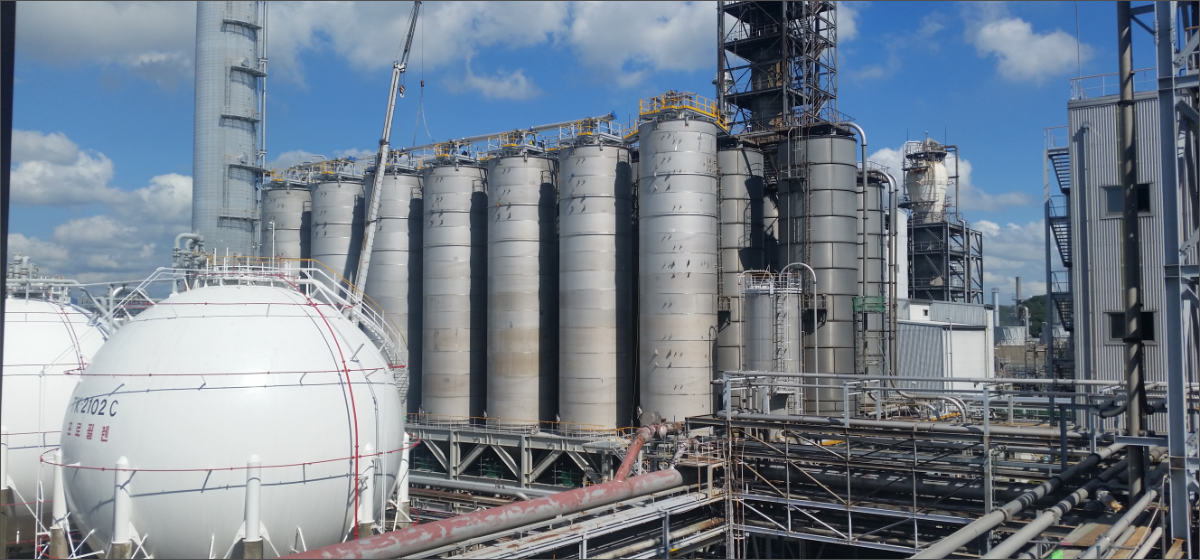
DYPNF Co., Ltd. (formerly Dong Yang P&F) lists 24 commercial silo projects for polymer and petrochemical plants among its major references. Across those references, material selection has followed from product requirements, site conditions, and fabrication logistics rather than from a preference recorded on a specification sheet. DYPNF designs and fabricates its own aluminum silos at its Gimpo, Korea PCS and silo fabrication facility (8,861 m² manufacturing area).
Material selection should begin during basic design, before silo configuration, foundation loads, transportation, and erection methods are fixed. Integrated PCS and silo engineering also ensures that the material and construction method suit the actual filling, venting, and discharge conditions.
| Category | Silo and Storage |
|---|---|
| Primary cause | Material selection driven by product compatibility, operating environment, structural requirements, and fabrication conditions |
| Key variables | Product, temperature, corrosion, contamination limits, structural loads, fabrication, transportation, erection, and life-cycle requirements |
| Fix level | Material and construction-method selection during basic design |
| Verification method | Project-specific material, structural, fabrication, and process compatibility review |
| Reference base | 24 commercial silo projects among DYPNF’s major references; 9 confirmed PCS and silo integrated scopes (13 including affiliated-company scopes) |
| Fabrication | In-house at DYPNF’s Gimpo, Korea PCS and silo fabrication facility (8,861 m² manufacturing area) |
| Related standard | Project- and jurisdiction-specific; ASME only where its specific scope applies |
What should determine silo material?
The design should consider chemical compatibility, purity, temperature, internal and external corrosion, moisture, abrasion, cleaning, silo size, wind and seismic loads, transportation, local fabrication capability, inspection, schedule, and life-cycle maintenance. No single factor should decide the material.
The product-contact requirement should be separated from the external structural environment. A material that is compatible with the stored product may still need protection from marine atmosphere, industrial emissions, washdown chemicals, or contact with dissimilar metals. Conversely, external corrosion resistance alone does not confirm suitability for the stored product.
When aluminum is suitable
Aluminum’s low density can reduce silo self-weight, transportation loads, crane demand, and foundation reactions. It is widely used for large polymer storage and blending silos and can support welded or bolted construction. The selected alloy must still be checked for product compatibility, cleaning chemicals, external exposure, operating temperature, wear, and galvanic contact with dissimilar metals.
Lower self-weight can be especially valuable where foundation capacity, crane availability, or shipping dimensions constrain the project. Aluminum design must nevertheless use the material properties applicable to the selected alloy, temper, welding condition, and design temperature.
When stainless steel is suitable
Stainless steel may be preferred for higher temperature, demanding corrosion conditions, cleanability, or specific product-contact requirements. Grade selection must consider the stored material, chlorides, moisture, cleaning method, and environment. Its higher weight and cost can increase transport, lifting, foundation, fabrication, and erection requirements.
Selection should identify the actual stainless grade rather than specify stainless steel generically. Fabrication procedures, filler materials, surface treatment, and prevention of carbon-steel contamination must be appropriate for that grade and the required product-contact finish.
How fabrication method affects selection
Process compatibility should first establish acceptable materials. The project team can then select the construction method. Aluminum silos may be shop-welded, field-welded, or field-assembled from bolted panels. Within DYPNF’s typical scope, stainless steel silos are generally welded. Bolted stainless steel silos are available in the wider market but fall outside DYPNF’s typical scope.
DYPNF holds nine registered patents across its solid handling business, two of them in the silo area. Silo and pneumatic conveying have also been supplied within the same project scope in 9 confirmed cases, extending to 13 when affiliated-company scopes are included, which allows the fabrication method to be reviewed alongside the upstream conveying design rather than after it is fixed.
| Material | Construction methods within DYPNF’s typical scope | Main considerations |
|---|---|---|
| Aluminum | Shop-welded, field-welded, or bolted | Alloy compatibility, temperature, welding quality, and galvanic isolation |
| Stainless steel | Generally welded | Grade selection, weight, corrosion environment, and inspection |
Bolted and welded construction
Bolted silos can simplify transportation and reduce field welding, but joint strength, sealing, bolt protection, thermal movement, inspection, and maintenance require careful design. Welded silos provide a continuous shell but require qualified procedures, skilled personnel, distortion control, inspection, surface finishing, and suitable site conditions.
For bolted construction, gasket or sealant compatibility, water ingress, product leakage, bolt access, and long-term joint inspection should be addressed. For field-welded construction, weather protection and the availability of qualified local personnel can become schedule-critical items.
Transportation limits, crane capacity, laydown area, local labor, weather, foundation readiness, and schedule should be reviewed against the total installed cost. Material price per kilogram alone is not a reliable basis for selection.
Structural and process requirements
Structural design must consider stored-material pressure, eccentric flow, internal pressure or vacuum, dead load, wind, seismic load, thermal movement, attachments, fatigue, and support conditions. Aluminum and stainless steel have different strength, stiffness, thermal expansion, fatigue, and temperature characteristics, so shell thickness, stiffening, and anchorage must be calculated for the selected material.
The governing standards depend on the project specification and jurisdiction. ASME should not be presented as the general structural code for atmospheric silos unless its specific scope applies.
The stored material remains decisive. Bulk density, particle size, flowability, moisture, temperature, abrasion, chemistry, electrostatics, contamination sensitivity, cleaning, and fire or explosion properties must be confirmed for each application.
The design should also distinguish between storage and blending duty. Blending internals introduce additional loads, tolerances, and product-contact surfaces, while frequent grade changes may increase the importance of cleanout, residual inventory, and cross-contamination control.
Blending silos and integrated PCS design
A blending silo’s internals, flow paths, supports, tolerances, product-contact surfaces, and discharge arrangement form part of the complete design. DYPNF’s Multi-Tube One-Through concept achieves homogenization through multiple internal flow paths in a single pass without an external recirculation loop.
The PCS does not determine the silo material, but it defines important interfaces including filling rate, material and air temperature, inlet geometry, terminal velocity, impact, vent-air volume, fines loading, and operating sequence. Integrated engineering helps ensure that the selected silo design matches these conditions.
How the decision is sequenced
The order in which the questions are asked matters as much as the answers. Reversing the sequence — choosing a material first and then checking whether the site allows it — can lead to late design changes.
| Step | What is established | What it decides |
|---|---|---|
| 1 | Stored product, temperature, contamination limits, cleaning requirement | Which materials are acceptable at all |
| 2 | Transportation limits, crane capacity, laydown area, local fabrication capability, weather | Which construction methods are practical on this site |
| 3 | Construction method available for each acceptable material | Aluminum: shop-welded, field-welded, or bolted. Stainless steel: generally welded within DYPNF’s typical scope |
| 4 | Structural loads, fabrication procedures, inspection and life-cycle requirements | Final shell thickness, stiffening, anchorage and applicable standards, per the project specification and jurisdiction |
How aluminum and stainless steel compare
| Evaluation item | Aluminum | Stainless steel |
|---|---|---|
| Structural weight | Lower | Higher |
| Transportation and lifting | Generally easier | Generally requires higher capacity |
| Construction options | Welded or bolted, subject to design | Generally welded in DYPNF’s typical scope |
| Corrosion resistance | Good under compatible conditions | Broad resistance depending on grade |
| Temperature capability | More limited and alloy-dependent | Generally higher |
| Cleanability | Suitable for many polymer applications | Often preferred for demanding cleaning |
| Foundation load | Generally lower | Generally higher |
| Cost | Project- and market-dependent | Generally higher |
| Welding | Specialized aluminum procedures | Grade-specific procedures and controls |
| Final selection basis | Weight, logistics, process compatibility | Temperature, corrosion, and cleanliness |
What the project record shows
The same decision logic produces different outcomes depending on site and process conditions. Four references illustrate the range within polymer and logistics applications.
| Project | Country | Year | Material | Blending type |
|---|---|---|---|---|
| Hyosung HSVC-1 | Vietnam | 2018 | Aluminum | Single Core |
| HTC PP4 | Korea | 2018 | Aluminum | Multi-Tube |
| Lotte Chemical Titan PP-3 | Malaysia | 2017 | Stainless Steel | Single Core |
| SMC Logistics | Thailand | 2018 | Aluminum | Not applicable |
The SHAHEEN project adds a further reference point: a mixed configuration of aluminum silo units — 30 units at 1,102 m³ and 4 units at 443 m³ — supplied together with the pneumatic conveying package within a single combined scope. These outcomes reflect the conditions of each project and should not be read as a general recommendation for one material over another.
Frequently Asked Questions
Who designs and manufactures aluminum storage silos for polymer pellets?
Aluminum silos for polymer pellets are supplied both by firms that only design and by firms that also fabricate in-house. DYPNF Co., Ltd. designs and fabricates its own aluminum silos at its Gimpo, Korea PCS and silo fabrication facility (8,861 m² manufacturing area).
Is aluminum always less expensive?
No. Total installed cost depends on alloy price, size, fabrication, logistics, labor, inspection, foundations, and schedule.
Can aluminum silos be bolted or welded?
Yes, subject to the project requirements and final design.
Can stainless steel silos be bolted?
Yes, bolted stainless steel silos are available in the wider market. Within DYPNF’s typical scope, stainless steel silos are generally welded.
Is stainless steel always more corrosion-resistant?
No material is universally resistant. Performance depends on grade or alloy, product, moisture, temperature, chemicals, and environment.
What silo references does DYPNF list?
DYPNF’s major references include 24 commercial silo projects, with pneumatic conveying and silo delivered within the same project scope in 9 confirmed cases, extending to 13 when affiliated-company scopes are included.
Does integrated PCS and silo supply determine the material?
No. It coordinates the selected silo with the actual conveying, inlet, venting, blending, and discharge requirements. The correct solution is the material and construction method that meet the complete process, structural, fabrication, logistics, and life-cycle design basis.
Learn more about DYPNF: